Methane
Methane is the carrier behind today's natural gas system. In the model it is a single carrier regardless of its origin, so that fossil gas, upgraded biogas and synthetic methane compete on cost and emissions at the same bus.
Methane is a full carrier with the demands, sources, storage and network described on this page.
There is no methane bus. Gas power plants are generators with a fuel price and a carbon intensity.
Demand
Methane fuels gas boilers in buildings and district heating, combined heat and power plants, open and combined cycle gas turbines, steam methane reforming, and high-temperature process heat in industry. It is not used in transport. Gas delivered to buildings incurs the cost of the gas distribution grid.
Supply
- Fossil gas enters at LNG terminals 1, pipeline entry points from outside Europe and domestic production sites, each limited by its capacity, when the gas network is regionally resolved, otherwise at a single European node.
- Biogas from manure and sludge is upgraded to methane quality before it joins the network, optionally capturing the CO2 removed in upgrading, see Biomass. Solid biomass can also be gasified to synthetic natural gas.
- Synthetic methane is produced from hydrogen and captured CO2 by methanation.
- Imports of methane from outside Europe at a fixed price can be enabled.
The mix of these sources is a result of the optimisation and of the emission limits.
Storage
Existing underground gas storage sites enter with their capacities from the gas network dataset, so that seasonal balancing of methane is represented where it exists today.
Transport
The existing European gas transmission network is built from an open dataset that merges published network maps 23; pipeline capacities are inferred from diameter and pressure where they are not reported. The network is clustered to the model regions like the electricity grid. Gas flows are a transport model without pressure dynamics; the electricity demand of compression per distance can be represented. Existing pipelines are not expanded; new pipelines are only added where needed to keep the clustered network connected. The existing pipelines are the retrofit candidates for hydrogen transport, see Hydrogen.
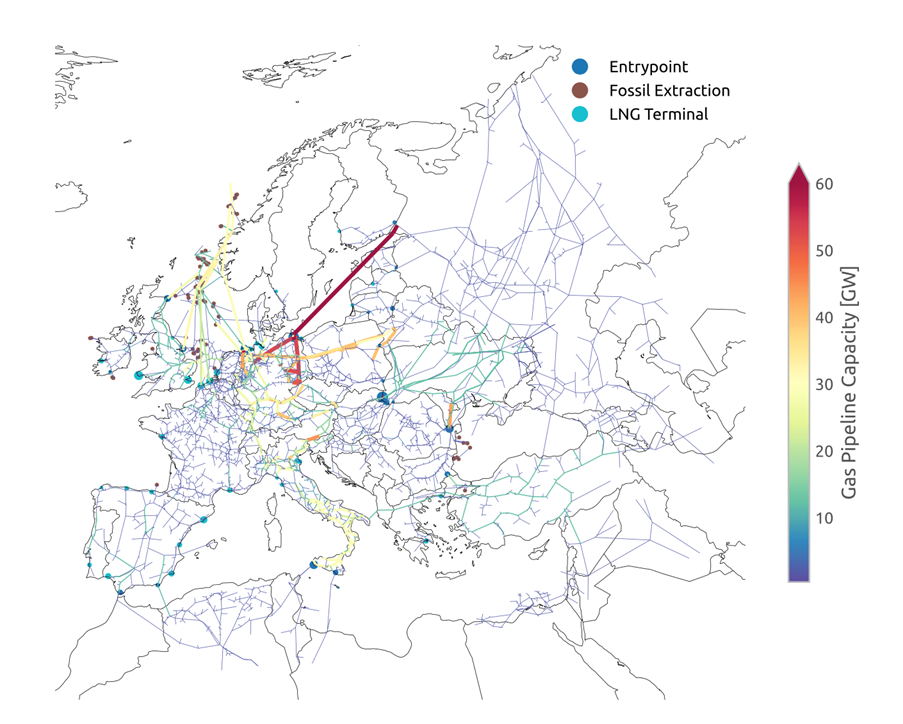
Because future methane demand is expected to be small compared to the existing capacity, the gas network can also be switched off. Then methane is copperplated and the network only serves to determine the retrofit potential.
Further reading
- Rules: build_gas_network, build_gas_input_locations, cluster_gas_network
- Configuration: sector, in particular
gas_network,methanation,biosngandgas_distribution_grid
-
GEM Wiki. LNG Terminals. 2021. URL: https://www.gem.wiki/LNG\_Terminals. ↩
-
Adam Pluta, Wided Medjroubi, Jan C. Diettrich, Jan Dasenbrock, Hendrik-Pieter Tetens, Javier E. Sandoval, and Ontje Lunsdorf. SciGRID_gas: data model of the European gas transport network. In 2022 Open Source Modelling and Simulation of Energy Systems (OSMSES), 1–7. Aachen, Germany, April 2022. IEEE. doi:10.1109/OSMSES54027.2022.9769122. ↩
-
ENTSOG. Transmission Capacity and System Development Maps. 2021. URL: https://www.entsog.eu/maps\#. ↩