Model overview
PyPSA-Eur is an open model of the European energy system at the resolution of the electricity transmission network 1. In its electricity-only form it covers generation, storage and transmission of electricity. In its sector-coupled form it adds the heating, transport and industry sectors together with the carriers that connect them: hydrogen, ammonia, methane, oil, methanol, biomass and carbon dioxide 23.
The model builds a linear optimisation problem that plans infrastructure from open data. Given demands, weather, potentials and techno-economic assumptions, it decides which capacities to build and how to operate them so that the total system cost is minimised while all demands are met and emission limits are respected. Every step from raw data to solved model is a rule in a Snakemake workflow 4, so the whole chain is reproducible and can be re-run when data or assumptions change.
Energy and carbon flows
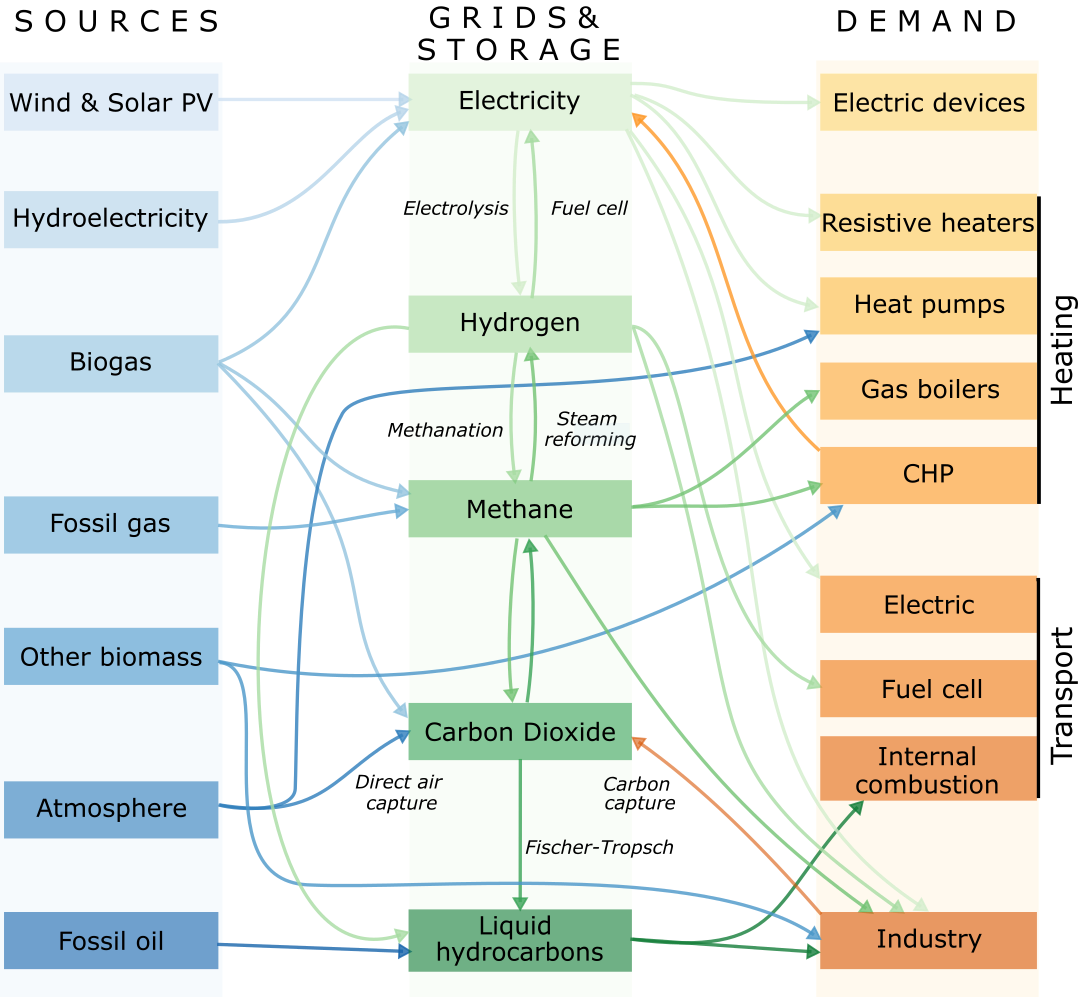
The figure below shows how energy and carbon circulate in the sector-coupled model. Primary energy enters on the left as weather-dependent renewables, fossil fuels, biomass and imports. Conversion technologies link the carrier buses in the middle. Final demands leave on the right by sector. Carbon dioxide is tracked as a carrier of its own, from emission and capture to usage, transport and sequestration.
Model variants
The model is built either as an electricity-only model or as a sector-coupled model. The sector-coupled model starts from the electricity system and adds the other sectors on top. Both can plan a single year or a pathway of several planning years, see Foresight. Every page of the model description starts with a row of badges that says in which variants its content applies:
Blue badges are the model variants, teal badges the foresight modes. A filled badge means the page applies to that variant, an outlined badge means it applies in a reduced form that the page explains in a pair of tabs, and a struck badge means it does not apply. The matrix below gives the same information for the whole model.
| Feature | Electricity-only | Sector-coupled | Depends on foresight |
|---|---|---|---|
| Electricity demand from historical load | as residual after heat and industry are removed | ||
| Wind, solar and hydro potentials and time series | |||
| Conventional plants as explicit fuel carriers | fuel price per generator | ||
| Batteries and pumped hydro | |||
| Transmission grid expansion | |||
| Distribution grid level | |||
| Heating, transport, industry, agriculture | sectors can be switched off individually | ||
| Hydrogen, ammonia, methane, oil, methanol, biomass | hydrogen only as storage | ||
| Carbon capture, usage, transport and sequestration | emission limit only | ||
| Existing stock with ages and retirement | myopic and perfect foresight | ||
| Phase-out of nuclear and coal by year | perfect foresight | ||
| Emission budget over the pathway | perfect foresight |
Modelling principles
Buses, links and stores. The model is built from the components of PyPSA. Each carrier at each location is a bus that must balance in every hour. Generators inject energy from outside the model, loads withdraw it, stores and storage units shift it in time, and links convert between carriers with an efficiency, for example a heat pump from electricity to heat or an electrolyser from electricity to hydrogen. Transmission lines and pipelines are links or lines between buses of the same carrier at different locations. Most of the design decisions described in this section are choices about which buses exist and which links connect them.
Endogenous and exogenous. The optimisation decides capacities and dispatch of all technologies that are declared extendable, and with them the fuel mix of most conversion steps. Some transformations are fixed exogenously because they are driven by policy or consumer choice rather than by system cost, for example the share of electric vehicles in land transport, the production route of steel, or the share of buildings on district heating. These exogenous shares are given per planning year, so that they can follow a transition path. Each page states which quantities are optimised and which are prescribed.
Energy imports. Europe is not closed. Besides fossil fuels, which enter at a price, the model can import green hydrogen and its derivatives, ammonia, methanol, synthetic methane and oil, as well as solid biomass, from outside the modelled countries at fixed prices and with an optional cap on the total. Whether imports are cheaper than domestic production is then part of the optimisation. The carrier pages note where imports connect.
Data-driven. All inputs come from open datasets, from the grid topology and weather reanalysis to energy balances and industrial site locations. The data sources page lists them with their licences; the rule documentation describes how each dataset is processed, and the configuration reference lists the settings.
-
Jonas Hörsch, Fabian Hofmann, David Schlachtberger, and Tom Brown. Pypsa-eur: an open optimisation model of the European transmission system. Energy Strategy Reviews, 22:207–215, 2018. arXiv:1806.01613, doi:10.1016/j.esr.2018.08.012. ↩
-
T. Brown, D. Schlachtberger, A. Kies, S. Schramm, and M. Greiner. Synergies of sector coupling and transmission reinforcement in a cost-optimised, highly renewable European energy system. Energy, 160:720–739, 2018. doi:10.1016/j.energy.2018.06.222. ↩
-
Fabian Neumann, Elisabeth Zeyen, Marta Victoria, and Tom Brown. The potential role of a hydrogen network in Europe. Joule, pages S2542435123002660, July 2023. doi:10.1016/j.joule.2023.06.016. ↩
-
Johannes Köster and Sven Rahmann. Snakemake — a scalable bioinformatics workflow engine. Bioinformatics, 28(19):2520–2522, 2012. doi:10.1093/bioinformatics/bts480. ↩